By Mrada Skincare
How to Read a Face Pack Label Before You Buy
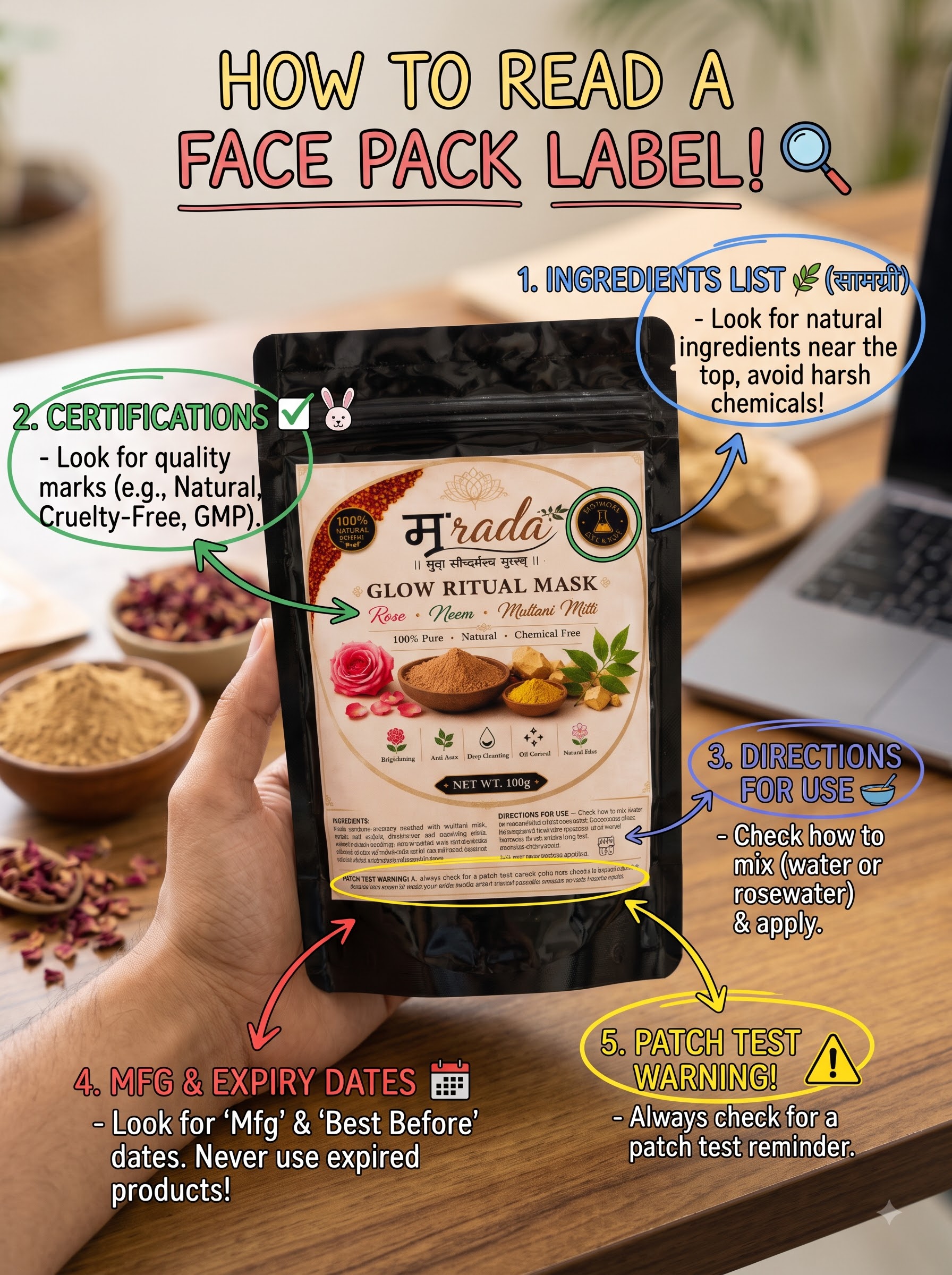
Front-of-pack words like "natural", "herbal" and "instant glow" tell you very little. A simple guide to the back of the pack: ingredients, net quantity, dates, batch number and the claims to be careful about.
The front of a face pack is designed to sell. Big words like "herbal", "natural", "glow" and "detox" sit next to pretty pictures of leaves and flowers. The useful information is almost always on the back, in small print. Here is how to read it in about a minute.
Start with the ingredient list
In India, cosmetics must list their ingredients. They are usually written in order of quantity, the largest first. So:
- If you are buying a "multani mitti pack", fuller's earth (or bentonite, kaolin or "clay") should be at or near the top.
- If the first few ingredients are fillers, perfume or starch, the hero ingredient is probably a small part of the mix.
- "Fragrance" or "parfum" is a common cause of irritation for sensitive skin. If your skin reacts easily, prefer packs without it.
You don't need to know every chemical name. You just need to see whether the ingredient you are paying for is actually the main one.
Check net quantity and price per gram
A 50 g pack and a 100 g pack can look the same size on a shelf or in a photo. Look for the net quantity and work out the price per 10 g. It is the fairest way to compare two products.
Find the dates
Look for the date of manufacture and either an expiry date or a "best before" period. A powder is fairly stable, but it still won't last forever, especially once opened in a humid home. If you can't find any date at all, that is a warning sign.
Look for the batch number
A batch or lot number tells you the brand can trace that pack back to when and how it was made. If there is ever a problem, this is how it gets traced. Serious manufacturers print it.
Check who made it and how to reach them
The label should name the manufacturer or marketer, give an address, and offer a way to contact them, like an email or customer care number. If a product has no address and no contact, you have no one to ask when something goes wrong.
Claims to read carefully
Some words are easy to print and hard to prove:
- "Organic": should come with a certification mark. Without one, treat it as marketing.
- "Chemical-free": everything, including water and clay, is made of chemicals. It usually means "without certain synthetic ingredients", which the label should name.
- "Instant fairness" or "removes tan in one use": no face pack changes your skin colour. Clay can lift oil and dead skin, which makes skin look brighter for a day.
- "Dermatologist recommended": fine if true, but it should say by whom or in what study.
- "Lab tested": good to see, but ask what was tested. Testing for heavy metals and germs is a meaningful safety check.
Read the usage and warnings
Good labels tell you how to use the product, how long to leave it on, how often, and when not to use it, such as on broken skin or near the eyes. They usually recommend a patch test. These instructions are worth following; they are often based on what can go wrong.
A quick checklist
Before you buy, check:
1. Is the main ingredient near the top of the list?
2. Is there a net quantity, a manufacturing date and an expiry date?
3. Is there a batch number?
4. Is there a name, address and contact?
5. Are the claims believable, or do they promise a miracle?
If a product passes these five checks, you can judge it on how it works for your skin. If it fails two or more, it is worth looking for another.