Skincare Essentials & Wisdom
Discover expert botanical insights, simple skincare routines, and honest advice from Mrada Skincare.

Why We Lab-Test Our Multani Mitti, and What the Results Mean
Clay comes out of the ground, and so can heavy metals and germs. Here is what a lab tested in our Multani Mitti mix, what "not detected" and "less than 10 cfu/g" mean, and what a test like this can and cannot tell you.
Multani mitti is clay. It is dug out of the earth, dried, ground and packed. That is exactly why people love it: nothing about it feels artificial. But "from the earth" also means it can carry things you don't want on your face. Clay can pick up heavy metals from the soil around it, and a damp powder can grow bacteria or fungus. You cannot see either of these by looking at the powder. So before selling it, we sent a sample of our Multani Mitti mix to an independent laboratory. This post explains what they checked, what they found, and what those results do and don't mean. Who tested it The sample was tested by METS Laboratories India Pvt. Ltd., Gurugram. The analysis ran from 28 May to 3 June 2026 (report no. METSINR/COD/260528/0009). We have the full report and are happy to share it with anyone who asks through our Contact page. What was tested: heavy metals The lab checked for three metals that are well known problems in cosmetics: - Lead - Mercury - Arsenic All three were "ND", which means not detected, at a detection limit of 0.1 ppm (parts per million). In simple words: the lab's equipment can see these metals down to 0.1 parts in a million, and it found none above that level in our sample. Why does this matter? Lead and mercury have turned up in some cheap face powders, creams and "fairness" products sold in India. They can be absorbed over time, and they are the reason many countries set strict limits for cosmetics. Testing for them is one of the most basic safety checks a clay product can have. What was tested: germs The second part of the test looked for microbes, using the Indian standard method for cosmetics (IS 14648): - Total viable count (all bacteria together): less than 10 cfu per gram - Total fungal count (yeast and mould): less than 10 cfu per gram - Staphylococcus aureus: absent - Pseudomonas aeruginosa: absent - Escherichia coli (E. coli): absent - Candida albicans: absent "cfu" means colony forming units, a way of counting living microbes. The lab notes that less than 10 counts as absent for this method. The four named organisms are the ones cosmetic standards specifically worry about, because they can cause skin, eye or wound infections. None were found. What a lab test cannot tell you We want to be just as clear about this part. - A test covers the sample that was sent. The report itself says its results apply only to the sample tested. We follow the same process for every batch, but a test is a snapshot, not a lifetime promise. - A safety test is not a "benefit" test. It shows the powder is clean. It does not prove that it clears acne or brightens skin, and we don't claim that. - It does not mean the product suits everyone. Clean clay can still be too drying for dry or sensitive skin. A patch test is still a good idea the first time. - It is not an organic certificate. Organic is a separate certification about how ingredients are grown. Our products are made with natural ingredients, and they are not certified organic. How you keep it clean at home The powder leaves us clean. Keeping it that way is partly in your hands: - Close the pack tightly after use. Moisture is what lets microbes grow. - Always take powder out with a dry spoon, never with wet fingers. - Mix only what you need for one use, and throw away leftover paste. - Store it in a cool, dry place, away from the bathroom's steam if you can. Why we're telling you this When you put something on your face every week, you deserve to know what is in it and what isn't. Most face-pack powders don't publish anything about testing. We'd rather show our work. If you have questions about the report, write to us and we'll answer them.
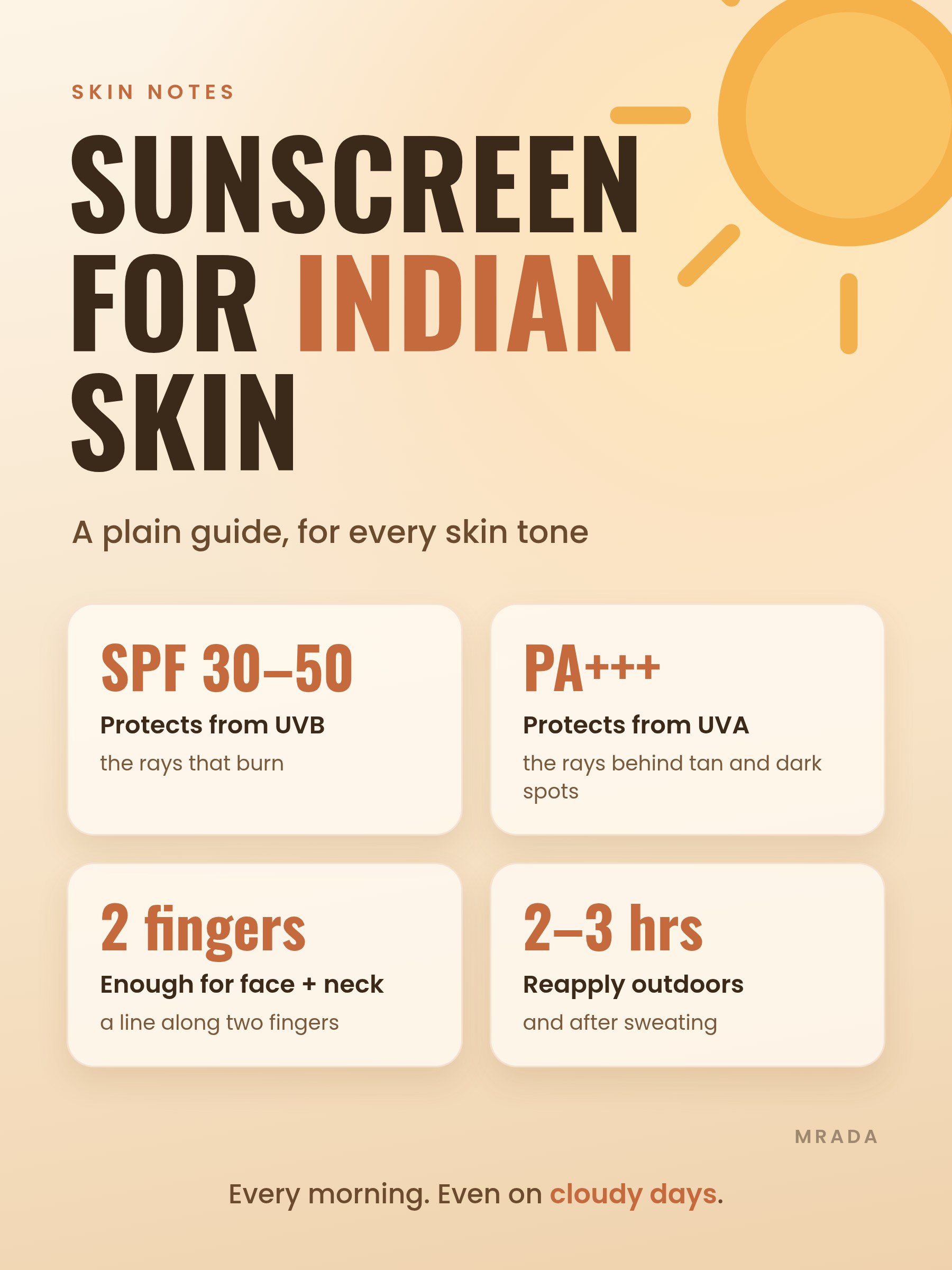
Sunscreen for Indian Skin: A Plain Guide
Sunscreen matters for every skin tone in India, not just fair skin. What SPF and PA mean, how much to use, when to reapply, and how to pick a texture you will actually wear every day.
If you only add one product to your skincare routine, make it sunscreen. Not a face pack, not a serum: sunscreen. And yes, that includes brown and dark skin. Indian sun is strong for most of the year, and it is behind a lot of the things people try to fix later with masks and creams: tanning, dark patches, uneven tone and early lines. "My skin is dark, I don't need it" Darker skin has more melanin, which gives some natural protection against burning. It does not stop tanning, and it does not stop pigmentation. In fact, many people with Indian skin find that dark spots and patchy tan are their biggest skin worries, and both get worse with sun. Sunscreen is the most effective way to prevent them. What SPF means SPF is about UVB rays, the ones that cause burning. SPF 30 blocks around 97% of UVB when used properly; SPF 50 blocks around 98%. For daily use in India, SPF 30 to 50 is a sensible range. Going higher than 50 adds very little. What PA means PA is about UVA rays, which go deeper, cause tanning and pigmentation, and pass through clouds and window glass. It is shown as PA+ up to PA++++. More plus signs mean more protection. For Indian skin, which tans and pigments easily, look for PA+++ or PA++++. You may also see "broad spectrum", which means the product protects against both UVA and UVB. How much to use Most people use far too little, which means they get a fraction of the SPF on the label. A simple guide is the two-finger rule: squeeze a line of sunscreen along the length of your index and middle fingers. That amount covers the face and neck. When to reapply Sunscreen wears off with sweat, wiping and time. Reapply every two to three hours if you are outdoors, and after sweating a lot or washing your face. If you are indoors all day away from windows, one morning application is usually enough. Picking a texture you will wear The best sunscreen is the one you don't skip. For Indian weather: - Oily skin: gel or "matte" fluid sunscreens feel lighter and don't add shine. - Dry skin: lotion or cream textures feel more comfortable. - If a sunscreen leaves a white or grey cast on your skin tone, try a tinted one or a different filter type. Many newer formulas are made for Indian skin tones. Where clay masks fit A clay mask and sunscreen work well together, as long as you remember the order. Use the clay mask in the evening, rinse, and moisturise. Wear sunscreen the next morning. Avoid going out in strong sun right after any exfoliating step, as freshly cleansed skin can be a little more sensitive. Common mistakes - Skipping it on cloudy or rainy days. UVA still gets through. - Only putting it on the cheeks. Forehead, nose, ears and neck get the most sun. - Relying on the SPF in makeup alone. You rarely apply enough foundation to get that protection. - Using an old, half-used bottle from last summer. Sunscreen expires; check the date. The simple version Every morning, after moisturiser, apply two fingers' worth of a broad spectrum SPF 30 to 50, PA+++ or more. Reapply when you are out in the sun. Do this every day for a few months and you will likely notice fewer new dark spots than any face pack could give you.

Tan Removal: What Actually Works and What Doesn't
A tan fades on its own as skin renews itself, usually over a few weeks. What speeds that up gently, which home remedies can make it worse, and how to stop the tan from coming back.
After a holiday, a wedding season or just a few weeks of summer commuting, most of us look in the mirror and want the tan gone, quickly. The internet is full of overnight fixes. Most of them don't work, and some of them hurt your skin. Here is what is actually going on, and what genuinely helps. What a tan is A tan is your skin protecting itself. Sunlight triggers cells called melanocytes to make more melanin, the brown pigment, which spreads into the upper layers of skin. Those upper layers are constantly being replaced. That is why a tan fades on its own, usually over two to six weeks, once you stop adding more sun on top of it. So tan removal is really two jobs: stop new tanning, and help the old, tanned surface cells leave a little sooner. Step one: stop adding to it This is the part people skip, and it matters most. Every day of unprotected sun adds new pigment while you are trying to fade the old one. - Wear a broad spectrum sunscreen, SPF 30 to 50 with PA+++ or more, every morning. - Reapply if you are outdoors for long. - Use shade, a cap or a dupatta when the sun is strong, roughly 11 am to 4 pm. Step two: gentle exfoliation Removing dead surface cells helps the tanned layer go faster. The key word is gentle. - A clay mask once or twice a week helps clear oil and dead skin from the surface, so skin looks fresher and more even. It won't remove a tan in one use, but it is a useful weekly step. - Curd or yogurt mixed into a face pack adds a little lactic acid, a mild exfoliant. - Over-the-counter exfoliating products with lactic or mandelic acid can help, used as directed and not with other scrubs on the same day. Step three: moisturise Well hydrated skin renews more evenly and looks less dull. Use a moisturiser suited to your skin type, morning and night. What doesn't work, or makes it worse - Lemon juice: very acidic, and on some people it causes burning and dark patches when they go out in the sun afterwards. - Baking soda, toothpaste or harsh scrubs: they damage the skin barrier. Irritated skin can actually produce more pigment. - Bleach creams used at home: they can cause irritation, and some products sold online contain banned ingredients like mercury or strong steroids. - Rubbing hard with a towel or loofah: friction is a known trigger for darkening, especially on Indian skin. If something stings or burns, wash it off. A tan is temporary; damaged skin can leave marks for months. How long should you wait With sunscreen every day and a gentle weekly routine, most tans fade noticeably within a few weeks. If you have patches that don't fade after two to three months, or patches that look different from a normal tan, such as melasma on the cheeks and upper lip, please see a dermatologist. Those need proper treatment, not home remedies. The short version Protect from new sun every day, exfoliate gently once or twice a week, moisturise, and give it a few weeks. It is not exciting, but it is what works.

Getting Your Skin Ready for a Wedding or Function: A Four-Week Plan
Last-minute facials and new products the night before are the most common way to ruin skin before a big day. A calm four-week plan, week by week, and what to avoid in the final days.
Every wedding season, the same thing happens. Someone books a strong facial two days before the function, tries a new product the night before, and wakes up red and irritated on the big day. Good skin before an event is mostly about starting early and keeping things simple. Here is a four-week plan. Four weeks before: set the routine - Settle on a simple daily routine: gentle face wash, moisturiser, and sunscreen every morning. - Start drinking enough water and getting regular sleep. Late nights show on the skin quickly. - If you want to try any new product, start it now. Four weeks gives you time to see if it suits you, and time to recover if it doesn't. - If you have active acne or pigmentation you are worried about, see a dermatologist now, not in the last week. Treatments need time. Three weeks before: add the weekly steps - Add a clay mask once a week, or twice if your skin is oily. This keeps pores clear and helps skin look fresh and even. - Do a patch test before the first use of any mask, even a natural one. - Keep up the sunscreen. Shopping trips and outdoor errands before a wedding add up to a lot of sun. Two weeks before: the last new things - If you are planning a professional facial, do it now. It gives your skin time to settle if there is any redness or breakouts. - If you are going to wax or thread your face, do a test session now so you know how your skin reacts. - Do a makeup trial if you can, using the same products you will use on the day. The final week: change nothing This is the most important rule. The last week is not the time to try anything new. - No new face packs, peels, scrubs or creams. - No strong facials, bleaching or chemical peels. - Keep using the same gentle routine you have used for the last three weeks. - Your regular clay mask is fine, but do it at least two or three days before the function, not the night before. - Threading or waxing: do it two to three days before, not on the day, so any redness has time to settle. The day before and the day itself - Cleanse gently, moisturise well, and sleep early. - On the day, moisturise before makeup so it sits smoothly. - Wear sunscreen if there are daytime outdoor events. - Carry blotting paper to control shine instead of adding more powder through the day. What to avoid completely - Lemon, baking soda, toothpaste or any viral "overnight glow" hack. - Squeezing pimples. A small spot is easier to cover than a scab or mark. - Scrubbing hard to "remove tan" in the last few days. The secret to good skin on the day is boring: start four weeks early, keep it gentle, and change nothing in the final week. Your skin will thank you in the photos.

A Simple Skincare Routine for Men
Most men want skincare that takes two minutes and fixes oily skin, razor bumps and a dull face. A no-fuss daily routine, how shaving fits in, and where a weekly clay mask helps.
A lot of men's skincare advice either says "just wash your face with soap" or tries to sell a ten-step routine. Neither works well. What most men need is short: something to keep oil in check, a way to stop razor irritation, and protection from the sun. Here it is. The two-minute daily routine Morning: 1. Wash with a gentle face wash, not bathing soap. Soap is made for the body and often leaves the face tight and dry, which can make it oilier later. 2. Apply a light moisturiser. A gel works well if your skin is oily. 3. Apply sunscreen, SPF 30 to 50, if you will be outside. A gel or matte sunscreen won't feel greasy. Night: 1. Wash your face to remove sweat, dust and oil from the day. 2. Moisturise. That is it. Three products: face wash, moisturiser, sunscreen. Shaving without bumps and burns Razor bumps and redness are among the most common skin complaints men have. A few habits help a lot: - Shave after a warm shower or after washing your face with warm water. Softer hair cuts more easily. - Use a shaving gel or cream, not just soap. - Shave in the direction your hair grows, at least on the first pass. - Use a sharp blade. A blunt one pulls and irritates. - Rinse with cool water and apply a fragrance-free moisturiser afterwards. Avoid alcohol-heavy aftershaves if your skin stings. Where a clay mask fits Men's skin often produces more oil, especially on the nose and forehead. A clay mask once a week helps keep that under control and clears the surface buildup that makes skin look dull. - Use it on a day you are not shaving, or at least several hours after shaving. Freshly shaved skin is more sensitive. - Mix a small amount with water to a smooth paste, apply a thin layer avoiding the eyes and lips, and leave it about 10 minutes. - Rinse with lukewarm water before it fully dries, then moisturise. A neem and clay mask is a common choice for oily, breakout-prone skin. Plain multani mitti works well too. Beard care If you have a beard, the skin underneath still needs care. Wash the beard area properly so oil and flakes don't build up, and use a little moisturiser or beard oil if it feels itchy. Don't put a clay mask into a beard; it is hard to rinse out and very drying for the hair. Common mistakes - Using body soap on the face every day. - Skipping moisturiser because the skin is oily. - Squeezing pimples, which can leave marks that last longer than the pimple. - Never wearing sunscreen, then wondering about tan and dark spots. When to see a doctor Painful, deep pimples, acne on the back and chest that doesn't improve, or razor bumps that keep getting infected are worth a visit to a dermatologist. A simple routine helps, but it isn't a treatment for medical skin problems. Keep it short, do it every day, and add one clay mask a week. For most men, that is all the routine they need.

Winter Skincare When Your Skin Is Oily in Some Places and Dry in Others
North Indian winters make combination skin confusing: a shiny nose with flaky cheeks. How to adjust your routine for the cold months without stripping the dry parts or clogging the oily ones.
Winter in North India does something strange to combination skin. The nose and forehead still get shiny by afternoon, but the cheeks start to feel tight and sometimes flake. Use your summer routine and the dry parts get worse. Switch to heavy winter creams and the oily parts break out. The answer is to treat the two areas a little differently. Why winter does this Cold air holds less moisture, and indoor heaters dry the air further. Hot showers, which feel so good in December, strip the skin's natural oils. The T-zone (forehead, nose, chin) has more oil glands, so it stays oily. The cheeks have fewer, so they dry out first. Cleansing: be gentler - Switch to a milder, non-foaming or low-foaming face wash if your summer one leaves your face tight. - Use lukewarm water, not hot. - Wash twice a day at most. Over-washing is the fastest way to make winter dryness worse. Moisturising: two textures if you need them - A light gel or lotion is enough for the T-zone. - The cheeks may need something richer: a cream moisturiser, or a second layer of your usual one. - Apply moisturiser to slightly damp skin, right after washing. It holds more water in. - If your lips and the skin around your nose crack, a thin layer of petroleum jelly at night helps. Clay masks in winter: only where you need them You don't have to give up clay masks in winter, but change how you use them. - Apply the mask only on the T-zone, not the cheeks. - Once a week, or once every two weeks, is plenty. - Mix it with milk or a little curd instead of water for a softer, less drying paste. - Take it off after 7 to 8 minutes, before it starts to dry and pull. - Moisturise straight away. This is sometimes called "multi-masking", and it is a simple way to give each part of your face what it needs. Don't forget sunscreen Winter sun feels gentle, but UVA rays, the ones behind tanning and pigmentation, are still there, and clear winter days in the hills or on the road can mean a lot of exposure. Keep wearing sunscreen in the mornings. Small habits that help - A humidifier, or even a bowl of water near the heater, makes the room less drying. - Drink water even when you don't feel thirsty; people drink less in winter. - Avoid scrubs on flaky cheeks. Flakes come off on their own once the skin is moisturised; scrubbing makes the area raw. When it's more than dryness Red, itchy, scaly patches that don't improve with moisturiser could be eczema or another skin condition. If that happens, see a dermatologist rather than trying more products. Winter combination skin is not a problem to fight. Clean gently, moisturise the dry parts more, use clay only on the oily parts, and keep up the sunscreen.

Common Skincare Myths We Hear All the Time
"Oily skin doesn't need moisturiser", "if it tingles it is working", "natural means safe". Eight myths we hear from customers, and what is actually true.
We get a lot of messages from customers, and some of the same ideas come up again and again. Many of them come from family advice, social media or old adverts. Some are harmless; some quietly make skin worse. Here are eight we hear most often. Myth 1: Oily skin doesn't need moisturiser Oil and water are different things. Oily skin can still be dehydrated, and when it is, it often produces even more oil. A light, oil-free gel moisturiser helps oily skin feel balanced. Skipping it usually backfires. Myth 2: If it tingles or burns, it is working A slight cooling feeling is fine. Stinging, burning or itching is your skin telling you something is wrong. Wash the product off. Good skincare should feel comfortable. Myth 3: Natural means safe for everyone Natural ingredients can irritate too. Neem, rose, lemon and essential oils all cause reactions in some people. Natural is a description of where an ingredient comes from, not a guarantee that it suits your skin. Always patch test something new. Myth 4: A face pack can make you fairer No face pack changes your skin colour. Clay masks lift oil and dead skin, so skin looks cleaner and brighter for a day or so. Real, lasting change in tan and dark spots comes mainly from sunscreen and time, and for stubborn pigmentation, a dermatologist. Myth 5: The more often you use a mask, the better Clay masks are a weekly step for most people, twice a week at most for very oily skin. Using one every day strips the skin and can leave it rough, flaky and, ironically, oilier. Myth 6: You only need sunscreen on sunny days or at the beach UVA rays, which cause tanning and pigmentation, pass through clouds and car and office windows. Daily sunscreen is one of the most useful habits for Indian skin, all year round. Myth 7: Toothpaste dries out pimples Toothpaste is made for teeth. It can contain ingredients that irritate and burn facial skin, sometimes leaving a dark mark that lasts longer than the pimple. If you have a spot, leave it alone or use a product made for acne. Myth 8: Expensive means better Price often reflects packaging, branding and advertising. A simple, well-made, fairly priced product used regularly will do more for your skin than an expensive one used now and then. Read the ingredient list, not the price tag. One more, about us People sometimes ask whether our masks are a treatment for acne or a fairness product. They are neither. They are cleansing clay masks that help oily skin feel clean and fresh as part of a weekly routine. We think it's better to say that clearly than to promise something no face pack can deliver. If you have heard a skincare tip and aren't sure whether to trust it, write to us through the Contact page. If we don't know, we'll say so, and if it sounds like a job for a dermatologist, we'll tell you that too.
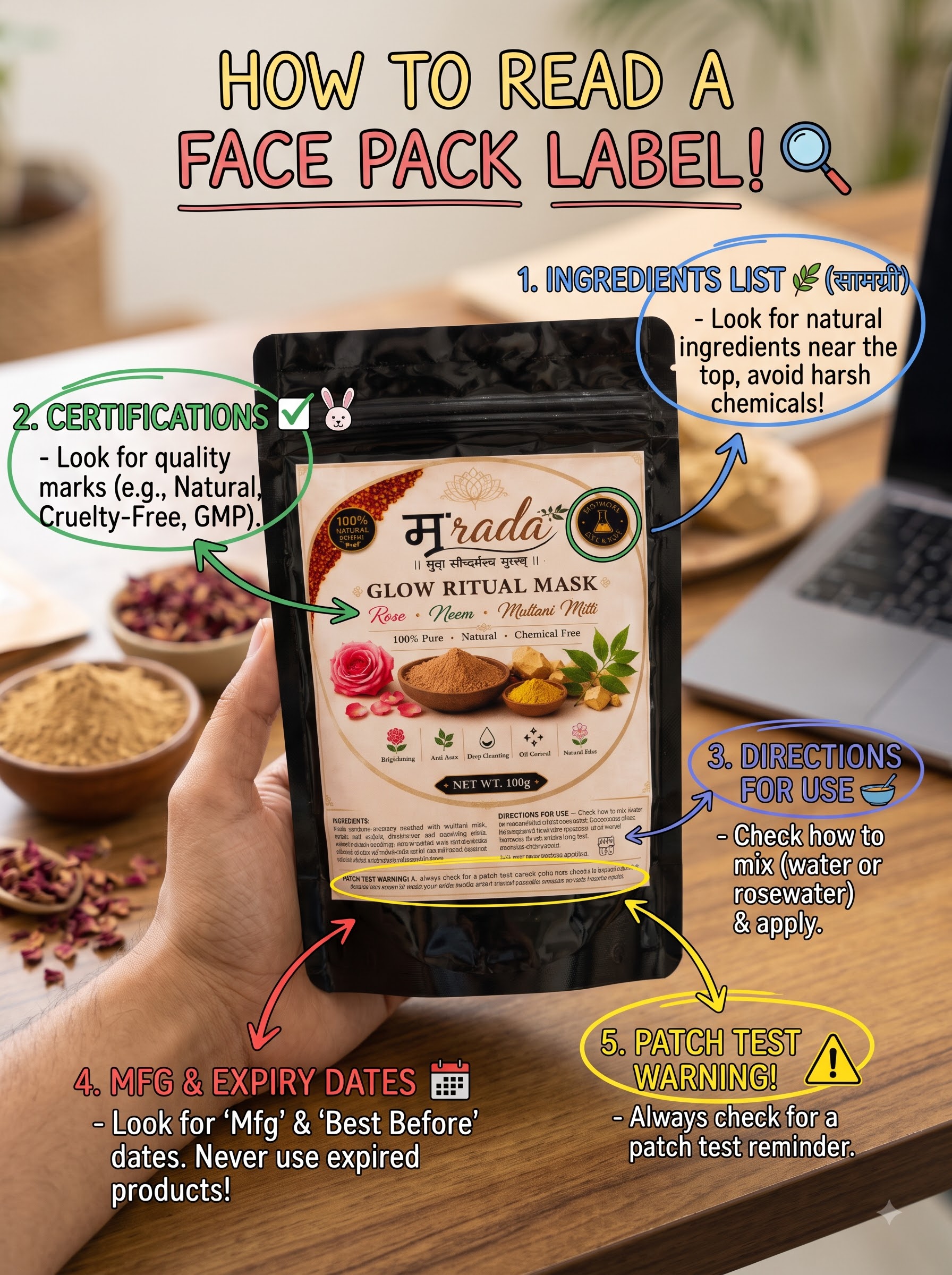
How to Read a Face Pack Label Before You Buy
Front-of-pack words like "natural", "herbal" and "instant glow" tell you very little. A simple guide to the back of the pack: ingredients, net quantity, dates, batch number and the claims to be careful about.
The front of a face pack is designed to sell. Big words like "herbal", "natural", "glow" and "detox" sit next to pretty pictures of leaves and flowers. The useful information is almost always on the back, in small print. Here is how to read it in about a minute. Start with the ingredient list In India, cosmetics must list their ingredients. They are usually written in order of quantity, the largest first. So: - If you are buying a "multani mitti pack", fuller's earth (or bentonite, kaolin or "clay") should be at or near the top. - If the first few ingredients are fillers, perfume or starch, the hero ingredient is probably a small part of the mix. - "Fragrance" or "parfum" is a common cause of irritation for sensitive skin. If your skin reacts easily, prefer packs without it. You don't need to know every chemical name. You just need to see whether the ingredient you are paying for is actually the main one. Check net quantity and price per gram A 50 g pack and a 100 g pack can look the same size on a shelf or in a photo. Look for the net quantity and work out the price per 10 g. It is the fairest way to compare two products. Find the dates Look for the date of manufacture and either an expiry date or a "best before" period. A powder is fairly stable, but it still won't last forever, especially once opened in a humid home. If you can't find any date at all, that is a warning sign. Look for the batch number A batch or lot number tells you the brand can trace that pack back to when and how it was made. If there is ever a problem, this is how it gets traced. Serious manufacturers print it. Check who made it and how to reach them The label should name the manufacturer or marketer, give an address, and offer a way to contact them, like an email or customer care number. If a product has no address and no contact, you have no one to ask when something goes wrong. Claims to read carefully Some words are easy to print and hard to prove: - "Organic": should come with a certification mark. Without one, treat it as marketing. - "Chemical-free": everything, including water and clay, is made of chemicals. It usually means "without certain synthetic ingredients", which the label should name. - "Instant fairness" or "removes tan in one use": no face pack changes your skin colour. Clay can lift oil and dead skin, which makes skin look brighter for a day. - "Dermatologist recommended": fine if true, but it should say by whom or in what study. - "Lab tested": good to see, but ask what was tested. Testing for heavy metals and germs is a meaningful safety check. Read the usage and warnings Good labels tell you how to use the product, how long to leave it on, how often, and when not to use it, such as on broken skin or near the eyes. They usually recommend a patch test. These instructions are worth following; they are often based on what can go wrong. A quick checklist Before you buy, check: 1. Is the main ingredient near the top of the list? 2. Is there a net quantity, a manufacturing date and an expiry date? 3. Is there a batch number? 4. Is there a name, address and contact? 5. Are the claims believable, or do they promise a miracle? If a product passes these five checks, you can judge it on how it works for your skin. If it fails two or more, it is worth looking for another.