By Mrada Skincare
Sunscreen for Indian Skin: A Plain Guide
Sunscreen matters for every skin tone in India, not just fair skin. What SPF and PA mean, how much to use, when to reapply, and how to pick a texture you will actually wear every day.
If you only add one product to your skincare routine, make it sunscreen. Not a face pack, not a serum: sunscreen. And yes, that includes brown and dark skin. Indian sun is strong for most of the year, and it is behind a lot of the things people try to fix later with masks and creams: tanning, dark patches, uneven tone and early lines.
"My skin is dark, I don't need it"
Darker skin has more melanin, which gives some natural protection against burning. It does not stop tanning, and it does not stop pigmentation. In fact, many people with Indian skin find that dark spots and patchy tan are their biggest skin worries, and both get worse with sun. Sunscreen is the most effective way to prevent them.
What SPF means
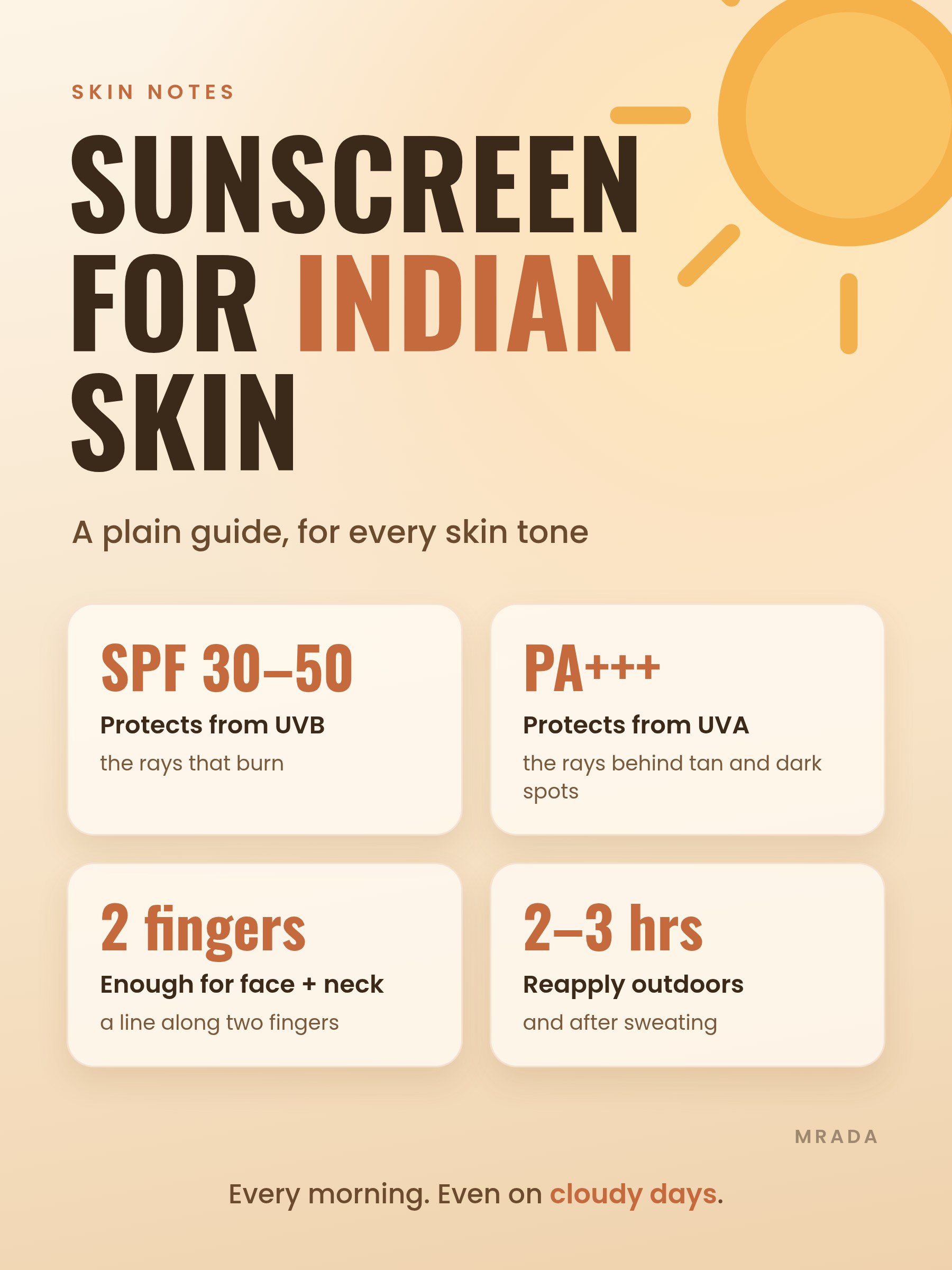
SPF is about UVB rays, the ones that cause burning. SPF 30 blocks around 97% of UVB when used properly; SPF 50 blocks around 98%. For daily use in India, SPF 30 to 50 is a sensible range. Going higher than 50 adds very little.
What PA means
PA is about UVA rays, which go deeper, cause tanning and pigmentation, and pass through clouds and window glass. It is shown as PA+ up to PA++++. More plus signs mean more protection. For Indian skin, which tans and pigments easily, look for PA+++ or PA++++. You may also see "broad spectrum", which means the product protects against both UVA and UVB.
How much to use
Most people use far too little, which means they get a fraction of the SPF on the label. A simple guide is the two-finger rule: squeeze a line of sunscreen along the length of your index and middle fingers. That amount covers the face and neck.
When to reapply
Sunscreen wears off with sweat, wiping and time. Reapply every two to three hours if you are outdoors, and after sweating a lot or washing your face. If you are indoors all day away from windows, one morning application is usually enough.
Picking a texture you will wear
The best sunscreen is the one you don't skip. For Indian weather:
- Oily skin: gel or "matte" fluid sunscreens feel lighter and don't add shine.
- Dry skin: lotion or cream textures feel more comfortable.
- If a sunscreen leaves a white or grey cast on your skin tone, try a tinted one or a different filter type. Many newer formulas are made for Indian skin tones.
Where clay masks fit
A clay mask and sunscreen work well together, as long as you remember the order. Use the clay mask in the evening, rinse, and moisturise. Wear sunscreen the next morning. Avoid going out in strong sun right after any exfoliating step, as freshly cleansed skin can be a little more sensitive.
Common mistakes
- Skipping it on cloudy or rainy days. UVA still gets through.
- Only putting it on the cheeks. Forehead, nose, ears and neck get the most sun.
- Relying on the SPF in makeup alone. You rarely apply enough foundation to get that protection.
- Using an old, half-used bottle from last summer. Sunscreen expires; check the date.
The simple version
Every morning, after moisturiser, apply two fingers' worth of a broad spectrum SPF 30 to 50, PA+++ or more. Reapply when you are out in the sun. Do this every day for a few months and you will likely notice fewer new dark spots than any face pack could give you.