By Mrada Skincare
Why We Lab-Test Our Multani Mitti, and What the Results Mean
Clay comes out of the ground, and so can heavy metals and germs. Here is what a lab tested in our Multani Mitti mix, what "not detected" and "less than 10 cfu/g" mean, and what a test like this can and cannot tell you.
Multani mitti is clay. It is dug out of the earth, dried, ground and packed. That is exactly why people love it: nothing about it feels artificial. But "from the earth" also means it can carry things you don't want on your face. Clay can pick up heavy metals from the soil around it, and a damp powder can grow bacteria or fungus. You cannot see either of these by looking at the powder.
So before selling it, we sent a sample of our Multani Mitti mix to an independent laboratory. This post explains what they checked, what they found, and what those results do and don't mean.
Who tested it
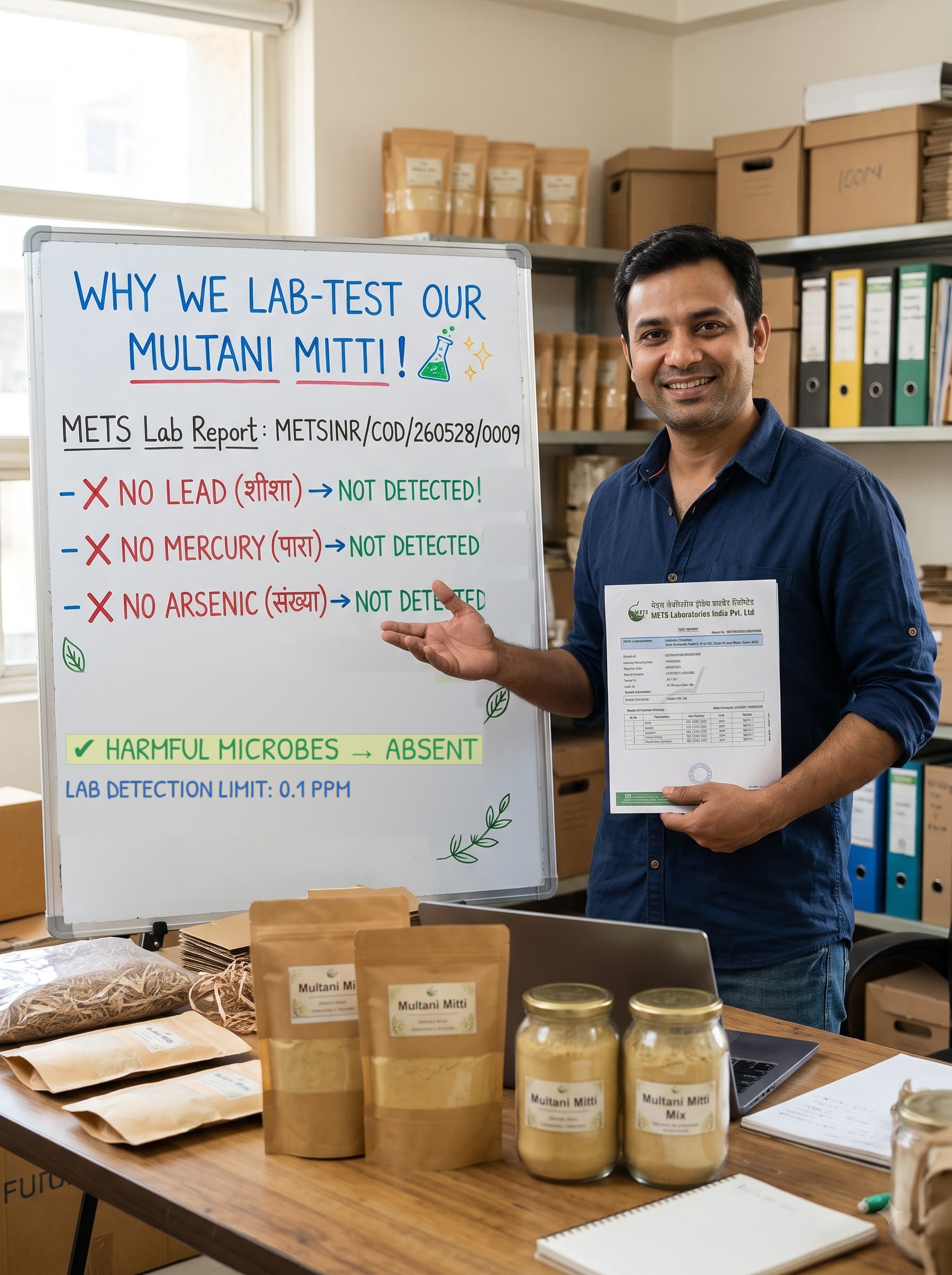
The sample was tested by METS Laboratories India Pvt. Ltd., Gurugram. The analysis ran from 28 May to 3 June 2026 (report no. METSINR/COD/260528/0009). We have the full report and are happy to share it with anyone who asks through our Contact page.
What was tested: heavy metals
The lab checked for three metals that are well known problems in cosmetics:
- Lead
- Mercury
- Arsenic
All three were "ND", which means not detected, at a detection limit of 0.1 ppm (parts per million). In simple words: the lab's equipment can see these metals down to 0.1 parts in a million, and it found none above that level in our sample.
Why does this matter? Lead and mercury have turned up in some cheap face powders, creams and "fairness" products sold in India. They can be absorbed over time, and they are the reason many countries set strict limits for cosmetics. Testing for them is one of the most basic safety checks a clay product can have.
What was tested: germs
The second part of the test looked for microbes, using the Indian standard method for cosmetics (IS 14648):
- Total viable count (all bacteria together): less than 10 cfu per gram
- Total fungal count (yeast and mould): less than 10 cfu per gram
- Staphylococcus aureus: absent
- Pseudomonas aeruginosa: absent
- Escherichia coli (E. coli): absent
- Candida albicans: absent
"cfu" means colony forming units, a way of counting living microbes. The lab notes that less than 10 counts as absent for this method. The four named organisms are the ones cosmetic standards specifically worry about, because they can cause skin, eye or wound infections. None were found.
What a lab test cannot tell you
We want to be just as clear about this part.
- A test covers the sample that was sent. The report itself says its results apply only to the sample tested. We follow the same process for every batch, but a test is a snapshot, not a lifetime promise.
- A safety test is not a "benefit" test. It shows the powder is clean. It does not prove that it clears acne or brightens skin, and we don't claim that.
- It does not mean the product suits everyone. Clean clay can still be too drying for dry or sensitive skin. A patch test is still a good idea the first time.
- It is not an organic certificate. Organic is a separate certification about how ingredients are grown. Our products are made with natural ingredients, and they are not certified organic.
How you keep it clean at home
The powder leaves us clean. Keeping it that way is partly in your hands:
- Close the pack tightly after use. Moisture is what lets microbes grow.
- Always take powder out with a dry spoon, never with wet fingers.
- Mix only what you need for one use, and throw away leftover paste.
- Store it in a cool, dry place, away from the bathroom's steam if you can.
Why we're telling you this
When you put something on your face every week, you deserve to know what is in it and what isn't. Most face-pack powders don't publish anything about testing. We'd rather show our work. If you have questions about the report, write to us and we'll answer them.